


Crisis prevention and preparation encompasses many different elements designed to (a) recognize and support student, family,and educator needs; (b) ensure student and educator physical and emotional safety and wellbeing during the school day and at school-sponsored events; (c) prevent student behavior from escalating with effective responses before behaviors become a threat, intervening before they become a threat to themselves or others; and (d) ensure all school community members know how torespond in the event of a crisis incident.
The MTSS provides aframework to enhance protective factors through more efficient, effective, andequitable implementation of crisis prevention and preparation efforts.
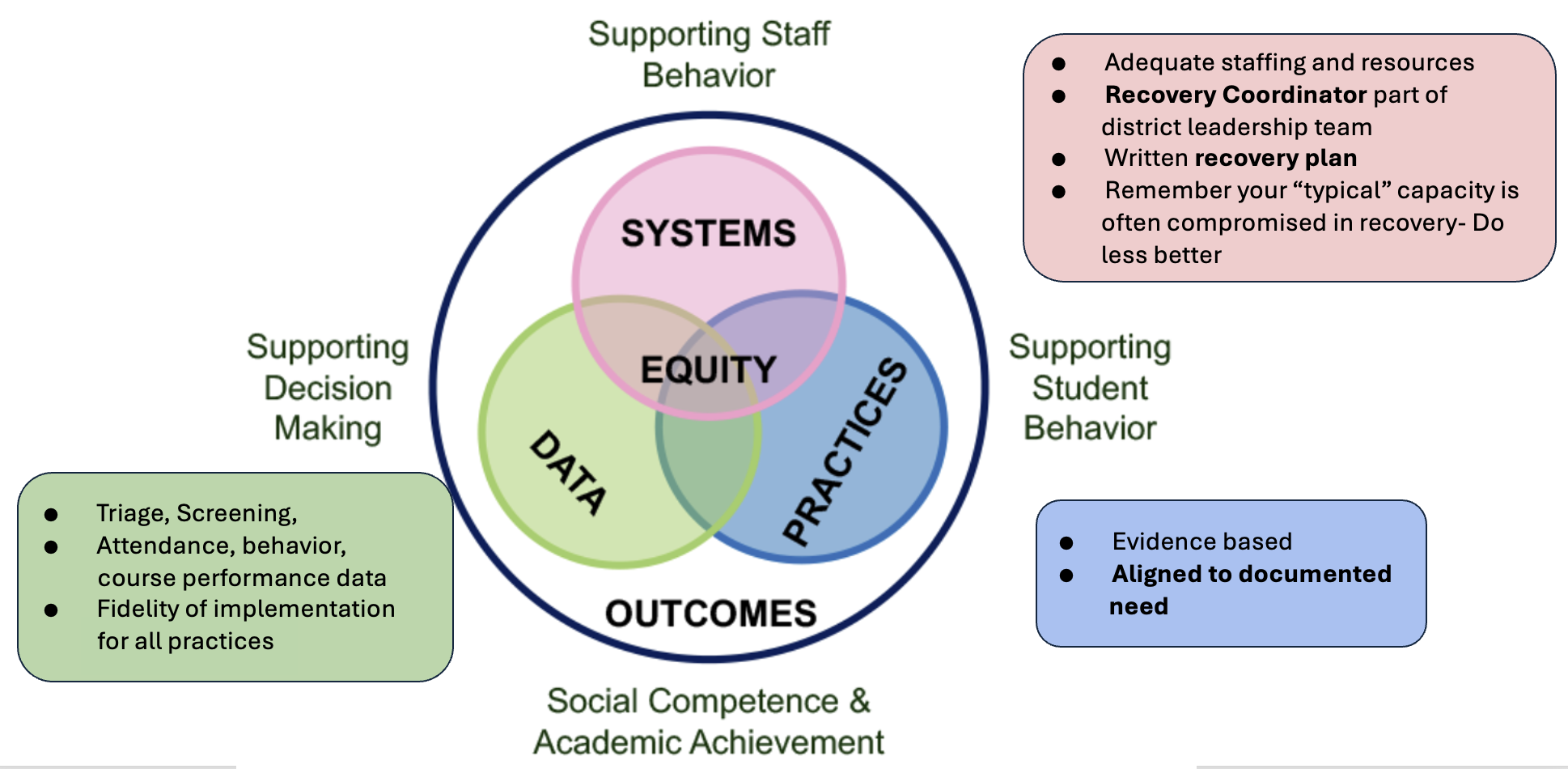
Outcomes: While we cannot prevent all crisis incidents, we can reduce the probability or mitigate the impact of some crisis events by intentionally building systems to enhance protective factors and stand ready to respond effectively in the event of a crisis incident. Identifying specific outcomes related to enhancing protective factors and improving preparation will guide the application of the MTSS framework and support integration with existing efforts
Systems are the structures supporting effective implementation of selected practices. For crisis prevention and preparation, this includes:
Data guides decision-making and implementation adjustments and should include:
Practices to support crisis prevention and preparation can be organized within a MTSS continuum of supports, just like academic or behavior supports. Teams would ideally consider which practices are beneficial for all students and educators (Tier 1), which are needed by small groups of students or educators (Tier 2), and which are needed by only a few students or educators (Tier 3). An example of how practices may be arranged is provided in a continuum below. However, the specific practices used by your school or district and the organization of those practices within tiers should align with local context and culture, address a clearly identified need, and be evidence-based.
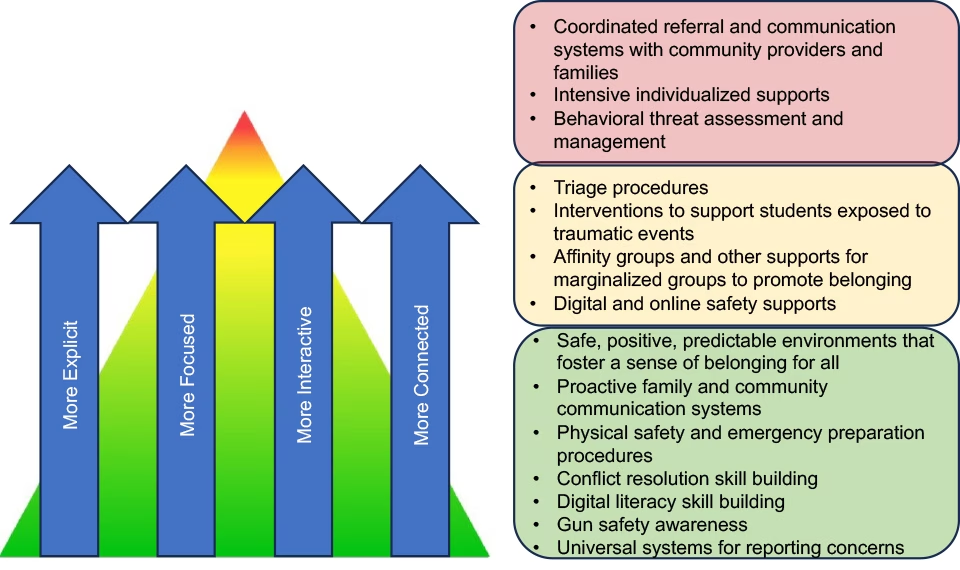
The MTSS continuum should be adjusted as needed to ensure that Tier 1 is intensive enough to support most students, Tier 2 includes an appropriate range of supports for groups needing more, and Tier 3 supports are aligned with identified individual needs. As conditions in your community change or as groups of students or educators are impacted by crisis events, teams may need to intensify supports by making them more explicit, more focused, more interactive, or more connected.
Establish a strong MTSS, such as PBIS, with an intentional focus on proactive mental health supports and a positive foundation of connection and belonging. (Learn more on the Mental Health/Social-Emotional-Behavioral Well-Being topic page).
SEAs and their state partners (e.g., statedepartment of health and human services, law enforcement, justice, emergency management, department of agriculture, environmental services, school safetycenter) serve critical roles in helping schools and school districts create and revise practices and protocols to continually protect the whole schoolcommunity before possible crisis incidents, as well as to respond and recover effectively. This may include enacting state mandates and enforcing laws thatenhance school safety; creating statewide systems to facilitate information-sharing and collaboration among schools and school districts, serving as a central repository for information; and providing general andtargeted TA and training.
If your district or state is looking for external support or technical assistance for crisis prevention or preparation, please contact your state PBIS coordinator.
Resources in this section include assessments, examples, and materials to aid in implementing PBIS.
Publications listed below include every eBook, monograph, brief, and guide written by the Center on PBIS.
Presentations about their experiences, published research, and best practices from recent sessions, webinars, and trainings
Recordings here include keynotes and presentations about PBIS concepts as well tips for implementation.
